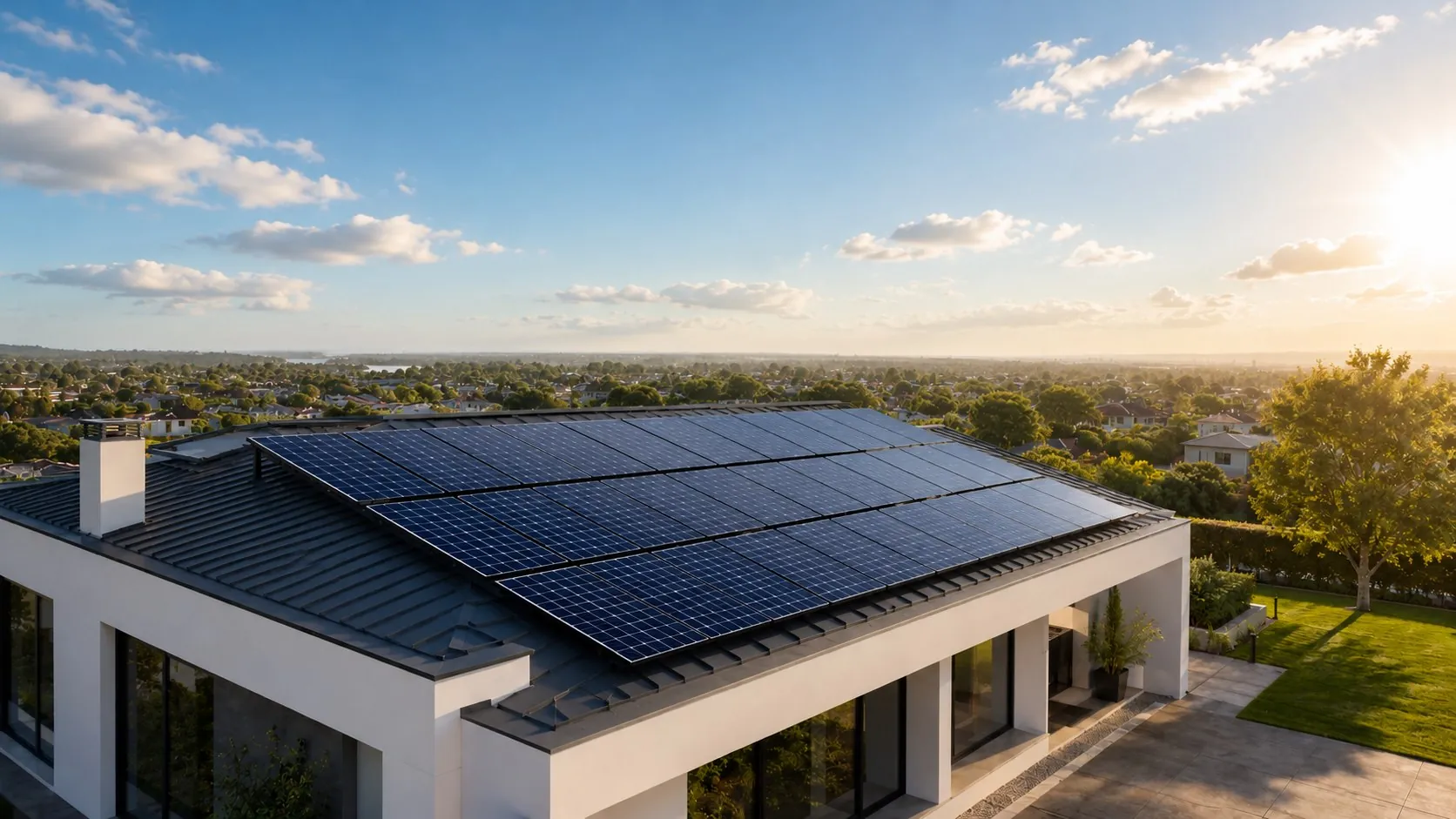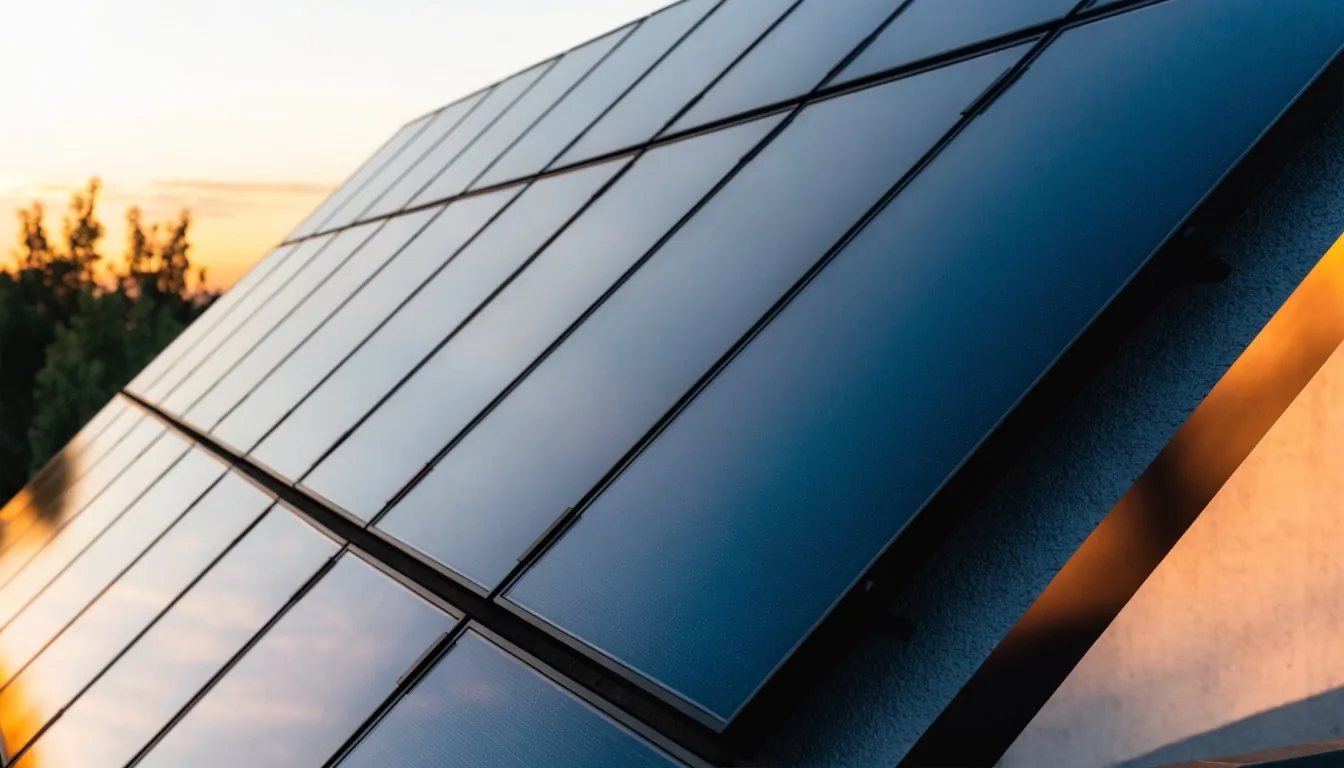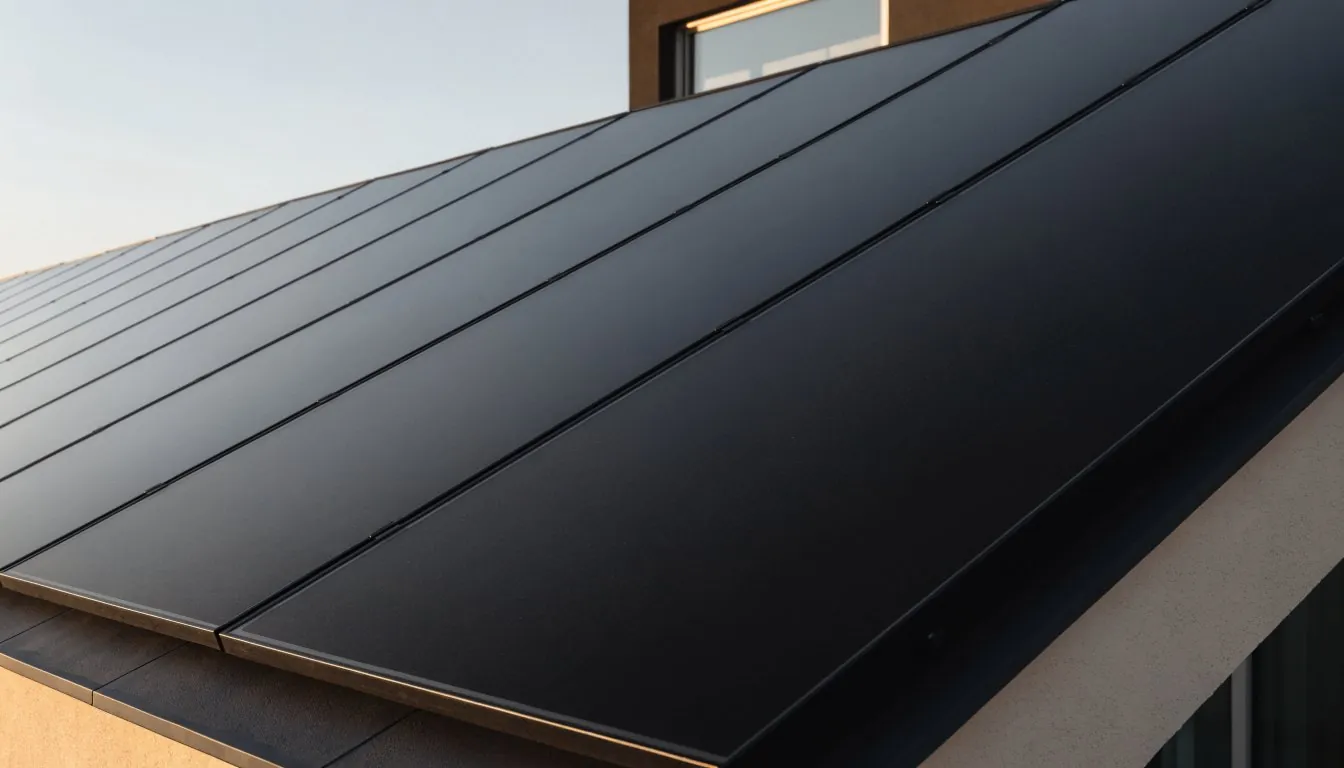
Every silicon solar cell has to get the electricity it generates off the front of the cell and into a circuit. For decades that has been done with thin metal lines printed across the face, the fine grid you can see on a conventional blue panel.
Those lines work, and they also sit exactly where the sunlight is trying to land. Every millimetre of metal on the front is a millimetre not collecting light. Back-contact architecture moves the whole electrical arrangement behind the cell, which does two things at once: it frees the front surface, and it removes the visible grid entirely.
That is the real difference between the two technologies in the Lewis range. The efficiency figures, the shade behaviour and the appearance all follow from where the contacts sit.
SunCore™, the dependable everyday choice
SunCore™ is the high-output range for homes, businesses and larger commercial installations, available from 570 to 650 W using advanced N-Type TOPCon cell technology. Module efficiency is model dependent, reaching up to 23.25% on selected 625 to 650 W models. Those selected dual-glass models are also bifacial, with a bifacial factor of 80% ±5%, generating from reflected light at the rear as well as direct light at the front.
Shade protection is standard bypass-diode protection, which is what the overwhelming majority of panels on the market use. There is no specialised cell-level optimisation.
For most roofs this is the right panel: open, largely unshaded, and with enough area that squeezing the last percentage point of efficiency out of every square metre is not the constraint.
SunCrown™ and SunCrown Black™
SunCrown™ is the flagship range, 650 to 685 W at up to 25.4% module efficiency, using N-Type back-contact cells with dual-glass bifacial construction. SunCrown Black™ uses the same cell platform in an all-black format at 515 to 540 W and up to 24.4%, with a clean uniform front surface and no visible metal grid lines.
Both add cell-level partial-shading optimisation and high-temperature restriction. Those two functions, rather than the appearance, are what justify the price.
| SPECIFICATION | SUNCORE™ | SUNCROWN™ | SUNCROWN BLACK™ |
|---|---|---|---|
| Cell technology | N-Type TOPCon | N-Type back-contact | N-Type back-contact |
| Power output | 570 to 650 W | 650 to 685 W | 515 to 540 W |
| Module efficiency | Model dependent, up to 23.25% on selected 625 to 650 W models | Up to 25.4% | Up to 24.4% |
| Partial shade | Standard bypass-diode protection | Cell-level optimisation and high-temperature restriction | Cell-level optimisation and high-temperature restriction |
| Appearance | Visible front-side contacts | Reduced front-side metallisation | All-black, grid-free front surface |
| Bifacial | Selected dual-glass models, factor 80% ±5% | Dual-glass bifacial | Dual-glass construction |
| Performance warranty | Up to 30 years according to the selected model. Refer to the applicable datasheet and warranty documentation. | ||
Three numbers that decide it
Efficiency is about area, not quality
A higher-efficiency panel is not a better panel in the abstract. It converts more of the light falling on a fixed area into electricity, which matters when the area is the constraint. If your roof can hold twice as many panels as you need, the cheaper, lower-efficiency panel is the better commercial decision. If your usable roof is small, high efficiency is the only route to the system size you want.
On a typical Addis compound this is the deciding factor more often than not. Roofs are frequently broken up by pitches, parapets, water tanks and service runs, so the usable area is smaller than the building footprint suggests, and the question becomes how much power can be fitted into the part that genuinely works.
Temperature coefficient is about location
Panels are rated at 25°C, and real roofs run hotter. The SunCrown platform has a power temperature coefficient of -0.26%/°C, roughly a quarter of a percent of rated output lost per degree above the test condition. In the highlands, where air temperatures are mild, this matters less than roof area does. In the lowlands it becomes one of the main determinants of delivered energy. There is a separate article in this series on exactly that split.
Degradation is about the twentieth year
The SunCrown platform is designed for low degradation: no more than 1% output reduction in the first year, no more than 0.35% annually from years 2 to 30, and guaranteed performance of at least 88.85% at year 30, subject to the applicable datasheet and warranty terms. Those three figures, rather than the day-one rating, describe what you actually own.
There is a fourth advantage that never appears in an efficiency figure. Copper-based interconnection avoids high-temperature firing and creates copper-to-copper connections, which improves resistance to the mechanical stress and micro-cracking that gradually reduce output over a panel's life. It is a durability feature rather than a performance one, and it is the sort of thing that only shows up in year fifteen.
So which should you buy?
If your roof is generous and unshaded and value is the priority, SunCore™ gives dependable N-Type TOPCon output at the best cost per watt installed. If roof area is limited, or you simply want the most from the space you have, SunCrown™ is the highest power and efficiency in the range.
Where eucalyptus, compound walls or water tanks create recurring shade, either SunCrown™ or SunCrown Black™ is worth the premium for the cell-level optimisation. And where the roof is visible and appearance matters, on a villa or a prominent frontage, SunCrown Black™ puts the same cell platform behind a grid-free all-black surface.
Common questions
What is the difference between TOPCon and back-contact solar cells?
TOPCon cells carry their electrical contacts on the front face as a fine metal grid. Back-contact cells move the contacts behind the cell, leaving more front surface available to capture light. That enables higher module efficiency and a grid-free appearance.
Is a higher-efficiency panel always worth paying for?
Only when roof area is the constraint. Efficiency describes output per square metre, so it matters most on small or partly usable roofs. On a large open roof, more of a lower-efficiency panel can reach the same system size for less.
Which is the most efficient panel in the Lewis range?
SunCrown™, at 650 to 685 W and up to 25.4% module efficiency, using N-Type back-contact cells. SunCrown Black™ reaches up to 24.4% in an all-black format, and SunCore™ reaches up to 23.25% on selected models.
Do all-black panels perform worse than standard ones?
Not on this platform. SunCrown Black™ uses the same N-Type back-contact cell technology as SunCrown™, including cell-level partial-shading optimisation. The power range differs by model, so compare the datasheet for the specific model quoted.
How long do these panels last?
The SunCrown platform carries up to a 30-year performance warranty according to the selected model, designed for no more than 1% degradation in year one and no more than 0.35% annually from years 2 to 30, with guaranteed performance of at least 88.85% at year 30.